Thursday, May 12, 2005

Is Music Industry's DualDisc Too Late?


Bought my first DualDisc music CD tonight. It's Dave Matthew's new "Stand Up." Good album.

For those of you who aren't familiar with the DualDisc format, it's a regular CD on one side, and a DVD on the other. One disc - just two different sides sandwiched together. This means that there is no writing on either side - the name of the album is written on the plastic center of the disc.

It's a great idea and captures a lot of the points that I brought up in this post way back in July 2004. It was a rant to the RIAA and the music industry that they needed to do something to convince people to purchase albums again (as compared to stealing/pirating them or legally purchasing music online).

I commented about what the dance/electronica music genre was doing - with cool packaging for their CDs, bonus CDs and sometimes even DVDs included with the album.

Read my old post here if you want to see what I said.

Well, DualDisc does a lot of these things. The jewel box is different from a regular CD. It's curved on one side and has a button on the front that you push to open the box. Cool. The first discs have decent liner notes, and the CD/DVD has good content on it. Not only does the DVD side feature videos and other extras, it also includes a surround sound 5.1 mix of the same album that's on the CD side. So playing it at home (or on new car with audio DVD players like most of the new Acuras).

Well it save the industry? I don't know about that, but it is the first actual tangible music CD I have bought in months. It's been iTunes for 95% of my music for the past few years.

-aB

It Isn't The Frisbee Dog Nationals, But It's Still Funny


I'm a big fan of the Frisbee Dog competitions, a Frisbee + Dog competition where the dogs (and their masters) do all sorts of crazy tricks. Every year at the Dogwood Arts Festival in basically my front yard at Piedmont Park in Atlanta, the dogs go at it. I love it because the dogs are having fun, the owners are having fun, and the crowds can't help from loving it - watching all of the craziness.

Well, this isn't the Frisbee dogs, but it's still pretty funny. This week over at Georgia Tech, the 2005 RoboCup U.S. Open was being held. The compeition ended with a bunch of programmed Sony AIBO robot dogs playing soccer. Snippet from CBS News/AP:

Hugging the sideline, the robot dog waddled down the field and hit a ball with its nose. The ball bounced off the goal post.

It was one of the University of Texas' last chances to get back in the game, which it eventually lost 2-0 to the reigning European champs from Dortmund University in Germany.


Robot dog soccer is one of five games that teams of scholars competed in during the 2005 RoboCup U.S. Open, held Monday at the Georgia Institute of Technology. The aim of the three-day competition, which ends Tuesday, is to develop software for better robots with the long-term goal of fielding a robot soccer team good enough to play a human team by 2050.

The compeition was close, but the team from Dortmund University in Germany won the match.

Read the entire story here.

-aB

Monday, May 09, 2005

Mac OSX Tiger's Dashboard Compromised


Via Slashdot, this post discusses a slightly dangerous and quite annoying vulnerability for Tiger's new Dashboard feature, the Konfabulator-copying new OSX eye candy that I've discussed here. Snippet from Slashdot:

If you're running Safari on OS X Tiger and go to this website, a 'slightly evil' Dashboard widget will be automatically downloaded and installed and can't be removed without manually removing the file from the Library folder and rebooting the computer. The widget is called Zaptastic and is a demonstration by the author of how easy it is to exploit Dashboard for nefarious purposes. The essay, released under the Creative Commons License, goes on to describe the many ways users can be taken advantage of...


The Web site discussed is Zaptastic. DO NOT go to that link if you're using Safari on a Mac with Tiger installed, unless you want to delete the downloaded widget yourself. It's not a necessarily "evil" widget, as the author's main purpose is to demonstrate the vulnerability.

Hope Apple fixes this soon. The whole idea that you aren't supposed to be able to delete widgets once you download them is rediculous. While if you can navigate down to the Widgets folder in your Home > Library, it does require a restart or two to truly clean them up. And Apple's help documentation says "You cannot remove widgets from the Widget Bar or change their order."

Boo, Apple. This is awful. I hope they fix this (as well as several other things) in 10.4.1. How did this get through testing?

-aB

Sunday, May 01, 2005

Got Multiple Monitors? Meet Mandolux.

Found a wicked site tonight. Mandolux.com. It's from a guy named Mando Gomez who's a photographer that has created desktop images for people with multiple computer monitors.

At home, I am blessed with two honkin' 19" LCDs on my main computer. It's awesome - dragging windows onto both screens and truly being able to multitask.

Now, I've cropped and placed some of my own images onto my screens, but for those not fortunate enough to have their own, check out Mandolux.com. The archive section of the site has plenty of cool images to use.

P.S. I would show you some images from Mandolux.com but Mando gets a bit upset with bandwidth hogs.

-aB

Thursday, April 28, 2005

Great Book for Mac Geeks


As I write this, my copy of the new Macintosh OS X operating system, code-named "Tiger" is on it's way to me via FedEx. This morning, The Wall Street Journal's Walt Mossberg said about Tiger:

Overall, Tiger is the best and most advanced personal computer operating system on the market, despite a few drawbacks. It leaves Windows XP in the dust.


The new OS includes Spotlight, a very powerful search function that will change the way people manage their documents and data files, a new iChat video conferencing application that you need to see to believe, a RSS-enabled Safari Web browser that I blogged about here way back in June 2004 and Dashboard.

Dashboard is a great idea. Unfortunately, it's not a new idea. A piece of software called Konfabulator (one of my personal favorite shareware apps) has been doing the Dashboard thing for several years. Apple decided to "borrow" the idea without compensating Arlo Rose, the Konfabulator creator. Good news for Konfabulator is that it is now available for Windows and is more than worth the $24.95 they ask for it.

So sorry for the rant. Got carried away there. This post is about a book, "Revolution in the Valley - The Insanely Great Story of How the Mac Was Made." Andy Hertzfeld, one of the major brains behind the Mac compiled this book from stories on his Web site Folklore.org about the Mac, written by the actual people who built the original Mac. It's a pretty, coffee table-like book with lots of pictures and nice design. For those who have read the stories on Folklore.org, some of the chapters will be second-time reading, but even for me it was great the second time around. And it $24.95, it's actually a good deal for a hardback book with quality paper and spot color on every page.

I'm not sure if Steve Jobs has taken this book off the shelves of the Apple stores.

More on Tiger tomorrow...

-aB

Wednesday, April 20, 2005

Two Interesting Stories on Google


Via Slashdot, here are links to two interesting stories on Google and how it's impacting the Internet.

Snippet from The Globe & Mail:

Although it may seem that Google is already well-along the path toward such an information-rich Utopia, the truth is that the current state of affairs is only a first foray into the world of information retrieval. Today's smartest search algorithms still only read words as text strings, failing to make much sense (at least in the way a human would) of the ones and zeroes churning through their distributed server clusters. This lack of semantic connection is something being worked upon by the founder of the Web himself (Sir Tim Breners-Lee, at MIT) in a radical re-design of how the Web is structured and an update of the communication protocols that hold it all together.


And a snippet from Fortune:

Microsoft was already months into a massive project aimed at taking down Google when the truth began to dawn on Bill Gates. It was December 2003. He was poking around on the Google company website and came across a help-wanted page with descriptions of all the open jobs at Google. Why, he wondered, were the qualifications for so many of them identical to Microsoft job specs? Google was a web search business, yet here on the screen were postings for engineers with backgrounds that had nothing to do with search and everything to do with Microsoft's core business—people trained in things like operating-system design, compiler optimization, and distributed-systems architecture. Gates wondered whether Microsoft might be facing much more than a war in search. An e-mail he sent to a handful of execs that day said, in effect, "We have to watch these guys. It looks like they are building something to compete with us."

He sure got that right. Today Google isn't just a hugely successful search engine; it has morphed into a software company and is emerging as a major threat to Microsoft's dominance. You can use Google software with any Internet browser to search the web and your desktop for just about anything; send and store up to two gigabytes of e-mail via Gmail (Hotmail, Microsoft's rival free e-mail service, offers 250 megabytes, a fraction of that); manage, edit, and send digital photographs using Google's Picasa software, easily the best PC photo software out there; and, through Google's Blogger, create, post online, and print formatted documents—all without applications from Microsoft.


Good stories on a company who's corporate mantra is "Don't Be Evil." It's hard to put a fence around what Google is...today as well as tomorrow. It's certainly more than a search engine.

-aB

Scratch my back and I'll, wait a minute, do I have to?

Colleague of mine added 'ole GumpRants.com to his BlogRoll. Alan's a pretty nice guy, so I will reciprocate.

By the way, you gotta love the name - DogBrainCentral.

It looks so pretty down there in the BlogRoll, between The Onion and DPReview.com. There's juxtaposition for ya.

Kumbaya, my friend, kumbaya...

-aB

Tuesday, April 19, 2005

I Want One. No, I Need One


I have a little trouble getting up in the morning. I know how to divide by nine, which is number of snooze minutes my Sony clock radio "Dream Bar" will give me. I snooze for about 40-50 minutes (or actually 45-54 minutes to be precise) every morning.

Clocky from this MIT student is the solution to my problem. An alarm clock on wheels. Here's a snippet:

Before you hit the snooze button a second time on this alarm clock, you'll have to hunt it down.

The shag carpet-covered robotic alarm clock on wheels, called Clocky, rolls away and hides.

The clock is the invention of Gauri Nanda, a graduate student -- and a person who occasionally oversleeps -- who works in the Media Lab at the Massachusetts Institute of Technology.


Looks kinda freaky with the shag carpeting. Make sure to keep all ferrets away from this device.

Read the entire story here.

-aB

Friday, March 25, 2005

Braves' Turner Field to Get World's Largest HDTV


Turner Field is about to get a new TV. 71 feet tall by 79 feet wide, it's a biggie.

Here's a snippet from DesignTechnica:

The world's largest outdoor high definition display (56,000 square feet) will greet and entertain Atlanta Braves fans at the newly renovated Turner Field this season.

The 5,600-square-foot Mitsubishi Electric Diamond Vision screen, which will be recognized by Guinness World Records at a special ceremony on March 23, is 71 feet tall and 79 feet wide, weighs 50 tons and has more than five million LED lights.

The new display consists of 266 panels that each contains 20 lighting units, resulting in a screen with nearly 5,200,000 LED (light emitting diode) modules that can faithfully reproduce 1 billion colors, and be clearly seen from almost any viewing angle.


When on, it needs about 400,000 watts of juice to keep it going. Let's just hope that the Braves have something good to put on the new screen this year.

Read the story here on DesignTechnica, via Gizmodo.

-aB

Monday, March 14, 2005

Another Great Pontiac Marketing Idea


The US is definitely behind the 8-ball when it comes to use of mobile phone technology, but a new campaign for Pontiac's new G6 sedan is perfectly timed, in my opinion.

I spoke about the G6 promotion with Oprah Winfrey here a few months ago, and complimented the program up and down. What I saw last night is just a clever and groundbreaking (at least for the United States).

I saw a commercial last night for the new Pontiac G6 "Catch a G6" viral/mobile campaign. Simple, but very clever campaign using the camera on most people's (at least in the G6 demographic) mobile phones. (I must admit, it's one of those "why didn't I think of that" ideas).

Basically, if you photograph a Pontiac G6 on the street with your cameraphone, send it into Pontiac (at the number/email provided), you are submitted into a drawing for $1 million, as well as a few G6 cars that they'll give away. Simple. Elegant. Great. Here's why:


  • It gets people specifically looking for G6s on the road (a dream of auto manufacturers);
  • It creates a database of potential GM buyers (and their cell phone/cell email numbers;
  • It's viral buzz-worthy (people are talking about it);
  • The site also features a G6 ringtone for your phone (I bet it sounds like the G6 exhaust);
  • It speaks to the demographic of the potential G6 buyer, speaking to them with a marketing campaign that they see as "clever" and "sophisticated." People who likely aren't interested in a G6 won't "get it," but Pontiac could care less.

This is one of the most simple SMS-oriented promotions I've seen here in the US. And I bet it will be effective.

Visit the Pontiac promotion site here.

-aB

Tuesday, February 08, 2005

ESPN Interviews Malcom Gladwell


Not exactly your typical ESPN interview, but ESPN's Jeff Merron interviewed Blink and The Tipping Point author Malcom Gladwell just before the Super Bowl and asked him to translate his thinking into sports references.

It's a great interview, and Malcom's thoughts and theories make complete sense in a sports environment. Here's a snippet of an interview question about what advice from Blink he'd give the Eagles:

Well, it would be slightly terrifying to talk to the players, given that I'm, at my best, 135 pounds. So I'd settle for an hour with Andy Reid. I'd tell him the story from "Blink" about Millennium Challenge, which was the $500 million war game the Pentagon conducted in 2001. It was an elaborate dress rehearsal for the Iraq War, with one side "playing" the U.S. and another team playing Iraq -- and Iraq won. The chapter is all about how that happened, and it focuses on a retired Marine Corps General named Paul Van Riper, who was playing Saddam Hussein.

Van Riper won by speeding up the game. The team playing the U.S. had all kinds of computer programs and decision-making systems, and experts on every conceivable problem. But when the war started, Van Riper hit them with so many unexpected plays so quickly that he forced them out of that kind of conscious, deliberate decision-making mode -- and forced them to rely on their instincts. And they weren't prepared for that. Van Riper, in a sense, went to the "no-huddle" against his much more formidable opponent. And his experience shows that being good at deliberate, conscious decision-making doesn't make you good at instinctive decisions.

That's why I've always been so surprised that more NFL teams don't use the no-huddle. It's not just that it forces your opponent to keep a specific defense on the field. It's that it shifts the game cognitively: it forces coaches and defensive captains to think and react entirely in the instinctive "blink" mode -- and when teams aren't prepared for that kind of fast-paced thinking crazy things happen, like Iraq beating the U.S. Andy Reid has to know that Belichick has an edge when he can calmly and deliberately plot his next move. But does he still have an advantage when he and his players have to make decisions on the spur of the moment? I'd tell Andy Reid to go no-huddle at random, unpredictable points during the game -- to throw Belichick out of his comfort zone.


Good interview. Great book.

-aB

MapQuest Gets Trumped by Google


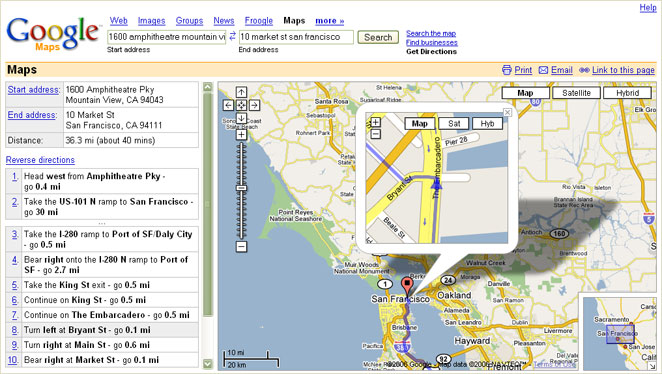
Google launced the beta version of its new mapping service today at maps.google.com.

And it's amazing. Smooth scrolling, drop shadows, live scrolling and zooming. It looks very Apple-like in the GUI. And that'a a compliment.

Unfortunately, the folks who would admire this the most - people using the Safari browser on the Mac, won't be able to see it yet. The site currently only works for IE and Firefox/Mozilla, according to Slashdot.

But if you're on IE, you're in for a treat. Check it out here. Sorry, MapQuest and Expedia Maps, you're going to have to evolve.

Monday, February 07, 2005

New Details on Sony PS3 Processor


Holy Crap. That's what I said when reading these specs.

Sony, IBM and Toshiba today announced some of the details of the Cell processor that they are all developing in collaboration. The PS3 will be the first application of this new smoker.

Now I don't know what all of this means, but I do know that big numbers are usually good and that these are some pretty big numbers:

  • The processor operates at greater than 4GHZ.

  • The processor is capable of 256GFLOPS. What that means is that the processor can handle 256 billion floating-point operations per second. That's billion with a "b" and per second as in, well per second. The Pentium 4 maxxed out these days is around 20 billion, to put this in perspective.

  • They're 234 million transitors on the little chip, pictured above between the push pins.

  • The processors are coming off the assembly line for testing. In other words, they're real.


NVIDIA is developing the graphic chip for the new PS3, and we can only hope that it is being built as aggressively as the CPU.

Amazing stuff. Read about it here on IGN. Read a more boring version (yet more detailed) of the same story here on ABC News.

-aB

iPods Don't Have Favorites. Promise. Steve Said So.


I have always felt that the "random" feature on iPods isn't really random. Sometimes, it just picks really good orders for songs in my playlist. I know this is just crazy talk, but many others have felt the same way.

Some think that their iPods have a thing for Steely Dan. Or maybe Alica Keys. For mine, it was James Taylor, Ian Van Dahl and U2 (especialy after the iPod/U2 commercials started - think about that conspiracy for a second).

But after many moons of research and now a statement from Stevie Jobs in Newsweek, it looks as though the algorithms that Apple developed are truly random. No affinity for certain songs, artists or BPMs (Beat Per Minute).

Engadget's statement is that "People love their iPods so much that they look for patterns in the pseudo-randomness. It’s what we do, as humans." Guess that makes sense.

Or does it?

Read the story here via Engadget.

-aB

Monday, January 24, 2005

Goodnight, Johnny.


Here's the last interview that Johnny did for Esquire magazine, way back in June of 2002. This was only one of two interviews that Johnny did after leaving The Tonight Show on May 22, 1992. (I think he also did an interview for the Washington Post).

This interview/article is by the excellent Bill Zehme. I know you'll like it - all ten pages of Carsonian glory.

-aB

Monday, January 17, 2005

The Genius of Apple. Again.


Have you seen the new iPod Shuffle? A pretty neat, albeit not necessarily new innovation. iRiver and Creative Labs have both made small, flash-based mp3 players for a year or two.

Apple's newest product is pretty similar to these. Subtle differences include the fantastic Apple Design and a USB-based rechargable battery (instead of reliance on AA or AAA batteries). It's also a pretty good value, with the 512MB flavor going for $99 and the 1GB going for $149. (Although iRiver and Creative Labs models have LCD screens and other features at this price point.)

I'm betting that the margin on this product is rather small. Apple is betting on making money on the acessories. Go into any Apple store around the country, and you'll see about 10-15% of the shelving in the store dedicated to earphones, cases, chargers and car adapters (rather than computers and software). Recently, Apple retail stores doubled store space dedicated to iPod accessories, breaking up iPod and iPod Mini SKUs into different departments to help alleviate traffic issues in the stores. Too many people crowding in too small a space. Who thought?

And get ready for more. Go to Apple's iPod Web page, and you'll see the dozen or so accessories that will be coming out for the Shuffle in the next few weeks. Accessories are where the money is.

But there is one accessory missing from this list. One thing - one accessory - that it made more sense to include with all new iPod Shuffles. Something it made sense to give away rather than trying to milk $12 out of each iPod Suffle buyer. What is it? A lanyard.

Why is this so important. It takes the Shuffle from being an audio player to being a FASHION ACCESSORY. It's an advertisment for Apple and the iPod product. Just like the trademark white earbuds have been an ad for an "iPod In Your Pocket," the Shuffle lanyard will be sandwich board on every early adopting consumer around the planet. Because they'll want to show off their new toy, too.

Good thinking.

-aB

Monday, January 10, 2005

Absolutely Amazing Use of RSS Technology


Today, someone showed me the Web site 10x10, at www.tenbyten.org. Basically, it culls the RSS news feeds every hour and picks the top 100 stories, and their corresponding images. Those images are then shown in a 10x10 grid that us updated hourly.

Their press materials do a lot better explaining it, so here's a snippet of their "Process";

Every hour, 10x10 scans the RSS feeds of several leading international news sources, and performs an elaborate process of weighted linguistic analysis on the text contained in their top news stories. After this process, conclusions are automatically drawn about the hour's most important words. The top 100 words are chosen, along with 100 corresponding images, culled from the source news stories. At the end of each day, month, and year, 10x10 looks back through its archives to conclude the top 100 words for the given time period. In this way, a constantly evolving record of our world is formed, based on prominent world events, without any human input.


Go take a look. Pretty cool. It's a lot like a photographic version of the "News Maps" that I discussed here at GumpRants.com back in August.

-aB

Friday, January 07, 2005

Cingular Wireless + Text Messaging = Tsunami Relief


Cingular is giving all of its customers with text message service the ability to donate to the tsunami relief in South Asia and East Africa.

Over the next week or so, Cingular cusomers will receive a text message from Cingular, telling them how they can donate. By replying to the text message, customers can choose which of three charities they'd like to contribute to (Red Cross, UNICEF and Save the Children). Customers can also choose to donate $0.99 or $1.99, the same cost of a ring tone. All of the money will go to the charities.

Read about the program here.

I have a Cingular phone. I'll let you know when I get the message.

-aB

Great Interview of Jeff Bezos


Wired online today is presenting a short, but good interview of Amazon.com CEO Jeff Bezos.

In the interview, Bezos speaks about Amazon.com's inventory model, the success of "Search Inside the Book," and about the declining "bricks and mortar" music business.

He also talks about his predictions for the percentage of retail that will be transacted online. Snippet:

I think online ultimately will be 10 to 15 percent of retail. The vast majority of retailing will stay in the physical world because people have acute needs, they want things now. Also, there are products, like a yard rake, where the economics of delivery don't make sense. But a 600-pound table saw is a great item to sell online because it always gets delivered. And it's expensive enough that there is enough profit in it to cover the cost of shipping. Plasma TVs, same idea.


At the end of the interview, Bezos shares why Amazon.com is no longer doing television advertising. Very interesting stuff. Enjoy.

-aB

Wednesday, January 05, 2005

Hi-Def Radio One Step Closer


2,500 stations have now signed on to broadcast digital radio signals from their ground towers using this new standard.

This is radio's response to XM and Sirrus satellite radio. The only problem is that HD radio will require new equipment, just like satellite radio. And they still have the issue of limitations on broadcasting using ground towers.

Here's a snippet of the release:

The company charged with developing the standard for digital radio in the United States said on Wednesday it has struck deals to convert another 2,000 stations nationwide to its format.

The industry-backed iBiquity Digital Corp. said the new AM and FM outlets would bring the total number of stations broadcasting in the digital standard, called HD Radio, to 2,500 across the country.

HD Radio, the traditional broadcast radio business's answer to satellite, promises CD-quality audio without static or hiss, along with supplemental data services like song information and traffic reports.


Read the full story here.

-aB