Wednesday, September 21, 2005

When the Pitch Becomes the Story

A work associate of mine, Nicholas Scibetta and I wrote the following piece for a monthly column on our corporate intranet. The column is called ".NEXT, the Bold New World of Media."

This month's column discusses an interesting change taking place today in PR firms and the media (including the blogosphere):

When the Pitch Becomes the Story

We’ve seen several examples over the past year of public relations professionals getting dinged by bloggers. Respected companies like American Express, Mazda and Dr. Pepper all received negative criticism when PR pros tried to unsuccessfully work with them. In general, the PR pros did two things wrong: They didn't fully disclose their clients' identity and they assumed incorrectly that bloggers lived by the same journalistic "code" as their mainstream media counterparts.

This unwritten code states that journalists will accept "off the record" comments as just that – off the record. The code also includes that reporters won't write about the "pitch," the actual act of marketing and presenting a story to a reporter.

Bloggers have proven that many of them don't adhere to this same code (and honestly, do they have to?). They often publish off the record statements in their posts and discuss the actual story pitch process. But traditional journalists still adhere to the code on their personal blogs, right? Wrong.

We know examples of journalists who have honored a media embargo with their traditional print publication, but posted the same story on their blog hours before the embargo was lifted. We know examples of reporters writing a balanced story for their employers' publications, but then writing different versions of the same story on their personal blog. This "inside baseball" is something we need to consider in public relations.

Journalist blogs have certainly created more transparency in the newsroom. Take Brian William's blog, "The Daily Nightly." Here, Brian writes daily about the goings on at NBC News, even providing us insight on how the day’s leading stories are selected. On his blog, Brian provides a glimpse of the editorial process to put The Nightly News together, including behind-the-scenes conversations between producers as to why and why not certain stories made it to air or didn't. Many newspaper outlets are encouraging their editors to write more about the why they cover what they do and how they go about doing it.

A recent story in The New York Times discusses how papers in the McClatchy Group, which owns the Sacramento Bee, The Star-Tribune(MN), and The News & Observer in Raleigh, N.C., are "undertaking 'accuracy audits' in which they survey people who appeared in articles to see if they were represented properly." Going even a step further, "some papers have invited citizens to sit in on their Page 1 meetings." CBS News' recently launched website features an ombudsman charged with, among other tasks, answering viewer questions about the workings of the news division.

This trend of "full disclosure" can be closely associated with the media's desire for the appearance of transparency and attempt to remain "sticky" with their current viewers/readers, while also attracting new ones. Living through the recent scandals involving the accuracy of quotes and existence of actual inside expert sources has put media somewhat on the defensive. This trend is certainly exciting. It's fun to have a view into the editorial process. But as public relations professionals, it should give us pause. It changes the rules. This isn't necessarily a bad thing – but it’s something we need to be ready for.

We need to ensure that our "pitch" can be distributed. We need to ensure that any additional background information that we give to a reporter can be published – either in the traditional publication or on their personal blog. And we might even want to consider the reporter's personal opinions and stance when we pitch them. While most journalists will work to deliver a balanced piece to their editor (as they are obligated to do), their personal blog, which might have a sizeable audience of its own, may share a different story (again, that's the reporter's discretion). Do the research, understanding the reporter's leanings can help you land a pitch and quite possibly prevent you from putting your client in a potentially adverse situation.

So the takeaway for today? Always pretend that you’re pitching Don Imus – someone famous for broadcasting the PR "pitch" as much as the story itself.


-aB

Thursday, September 15, 2005

REUTERS: Proof That The President Pees


This image, with the following slug, went out on the Reuters wire today:

U.S. President George W. Bush writes a note to Secretary of State Condoleezza Rice during a Security Council meeting at the 2005 World Summit and 60th General Assembly of the United Nations in New York September 14, 2005. World leaders are exploring ways to revitalize the United Nations at a summit on Wednesday but their blueprint falls short of Secretary-General Kofi Annan's vision of freedom from want, persecution and war. REUTERS/Rick Wilking


Surprise! Presidents pee, too. They also eat, brush, floss, scratch, poop and probably sing in the shower. And, according to our former President Carter, they also "lust in their heart."

No matter which side of the political fence you stand on, it’s pretty obvious the objective of this wire release and its bias. What's the journalistic purpose of this story? Did we not realize that the President had bodily needs before this important news story?

I’m just curious why we didn’t see a photo wire release like this about six years ago…


Just having fun with the camera phone.

-aB

Monday, September 12, 2005

Bypass That Customer No-Service Phone Tree...


Tired of the ridiculous IVR phone trees and other firey hoops you have to jump through to speak to a live human anymore? Me, too.

That's why I was very excited to come across this "Find-A-Human" Web page, listing the "back doors" and other secrets to quickly speak to a live human at about 60 businesses.

The tactic recommended for Cingular - to pretend like you're cancelling the service to get a live human IMMEDIATELY is one that I figured out a long time ago and have used successfully for Comcast, Chemlawn, and Chase. They all go to the same customer service operators - it's just a matter of where you are placed in queue.

Good site!

-aB

Wednesday, September 07, 2005

NerdTV


I've always been a fan of Robert X. Cringely's books and specials on PBS. He has a new show, called NerdTV that, in his words is the "Charlie Rose for geeks."

The NerdTV Web site provides video of the entire shows, transcripts and MP3 files of the shows, all under a Creative Commons license. Pretty neat stuff. Snippet:

NerdTV is distributed under a Creative Commons license so viewers can legally share the shows with their friends and even edit their own versions. If not THE future of television, NerdTV represents A future of television for niche audiences that have deep interest in certain topics.


This week's show is an interview with Andy Hertzfeld. Andy was the original Macintosh systems programmer and someone I'm a pretty big fan of. I blogged on Andy's book, Revolution in the Valley - The Insanely Great Story of How the Mac Was Made here on GumpRants.com on April 28. Take a listen to Andy's interview, and check out the book here.

Good stuff.

-aB

Tuesday, September 06, 2005

Myst Creator Cyan Closes Its Doors


Remember Myst? I do. I remember purchasing a copy of this game when I was still in college, right before finals (very, very bad idea). It was the first computer game that so captivated me that I remember playing for 12 or so hours straight. I was enthralled by it, not only by the game itself, but by the idea that you could become so immersed in what really was just a highly rendered slide show. It was eye candy, on a whole new level. And a demonstration that good content trumps almost everything else.

(Aside: I wasn't the only one enthralled by Myst. It ended up selling over 12 million copies and being the top-selling PC game of all-time until The Sims came around a few years ago.)

Myst producer Cyan closed it's doors on Friday, a few weeks before Myst V hits the shelves.

So, why is the creator of one of the best selling games of all-time closing? My rant is that Cyan didn't keep up with the technology evolution in PC gaming, something that changes even faster than Moore's Law. The Myst successors like Riven and Uru were good games, but still not 3D-based, years after full-screen animation began to be the expected norm for PC-based video games. Now it wasn't only Cyan and Myst that didn't keep up - the entire "adventure game" genre was impacted the same way.

Also, Cyan really didn't stray far enough from the Myst franchise. All of their games were Myst-based - all sequels. The Myst franchise got tired (not a huge surprise after twelve years) and they didn't have any other game brands (or seemingly ideas) to fall back upon.

So long, Cyan.


-aB

Friday, September 02, 2005

Corporate Generosity


I'm usually not a fan of Wal-Mart, but this announcement changes that:

BENTONVILLE, Ark., Sept. 1 - Following President Bush's announcement today that former Presidents Bush and Clinton will lead a nationwide fundraising effort to help the victims of Hurricane Katrina, Wal-Mart President and CEO Lee Scott contacted President Clinton and the White House and committed $15 million from Wal-Mart to jump-start the effort.

As part of this commitment, Wal-Mart will establish mini-Wal-Mart stores in areas impacted by the hurricane. Items such as clothing, diapers, baby wipes, food, formula, toothbrushes, bedding and water will be given out free of charge to those with a demonstrated need.

Wal-Mart previously donated $2 million in cash to aid emergency relief efforts and has been collecting contributions at its 3,800 stores and CLUBS, and through its web sites www.walmartfacts.com, www.walmart.com, www.walmartfoundation.org, www.walmartstores.com and www.samsclub.com.

Through its Associate Disaster Relief Fund, the company will also give displaced associates immediate funds for shelter, food, clothing and other necessities.

Wal-Mart Stores, Inc. operates Wal-Mart Stores, Supercenters, Neighborhood Markets and SAM'S CLUBS in all fifty states. Internationally, the company operates in Puerto Rico, Canada, China, Mexico, Brazil, Germany, United Kingdom, Argentina and South Korea. The company's securities are listed on the New York and Pacific stock exchanges under the symbol WMT.


Remember, you can give too, at www.RedCross.org.

The Gulf Coast needs our prayers and financial support.

-aB

Monday, August 15, 2005

Terrell Owens Needs To Get a Life


Watch any SportsCenter last week? Listened to any sports talk radio? Read any sports pages lately?

If you have, you've read all about Baby Terrell.

I just got done reading this editorial by Sports Illustrated's Peter King.

Awesome. Agree 100%. Snippet:

Go back to the Eagles on Wednesday, T.O., shut that massive piehole, play football and try to prove to some of us who think you're the worst kind of problem with American sports today that we're wrong. Please.


Gotta love it.

And if the Eagles don't waver here, I'll be a fan for life. This is what is wrong with pro sports.

-aB

Friday, August 12, 2005

Things We Miss...


CNet today (via Gizmodo) has a great list of tech things that they miss, and I must admit, I agree with almost all of them:

- Kozmo.com
This was a company ahead of its time. So was Webvan. The idea that you could go online and order up a frozen pizza, 6-pack and DVD was just about perfect. We had Kozmo in Atlanta when I lived there, and they practically saved my life when I got sick and needed some Pepto Bismol - fast.

(Aside - I had to go online to find out how to spell Pepto Bismol and found the Pepto-Bismol.com Web site. Very funny.)

- The Concorde
Never got to go faster than the speed of sound. Damn.

- Good Keyboards
Where is an originial IBM Model M Keyboard when you need one?

- The Newton
Yes, I am a dork. I have two. A MessagePad 110 and a MessagePad 2000. They made the move to Pittsburgh with me. Need to fire it up.

This story at CNet has the rest, compiled by Rafe Needleman. This should be a ongoing column!

-aB

Tuesday, August 02, 2005

Apple Finally Gives In To a Two-Button Mouse. Sort of.


Many have long complained that Apple never had a piece of mouse hardware with more than one button. Ever since the Lisa (and my Apple Mouse that I installed on my Apple //e long ago), Apple's been a one-button mouse sort of company.

Until today. Apple today releases not a two-button mouse, but actually a four-button mouse. But you say, they're no visible buttons. Here's a snippet of how Apple's copywriters explain it:

Meet the mouse that reinvented the wheel. The scroll wheel, that is. At $49, Mighty Mouse features the revolutionary Scroll Ball that lets you move anywhere inside a document, without lifting a finger. And with touch-sensitive technology concealed under the seamless top shell, you get the programability of a four-button mouse in a single-button design. Click, roll, squeeze and scroll. This mouse just aced the maze.

Spry and Mighty
In the beginning, there was one button. Then there were two. Then there were clickable scroll wheels and programmable toggles and solid-state slides. But nobody made a mouse as easy to use as your Mac. Until now. Mighty Mouse combines the capability of a multibutton mouse with Apple’s signature top-shell design for the best of both form and function. Use it any way you work: Stick with single-button simplicity or click with multibutton efficiency.


It's $49, which isn't bad. It's Windows compatible, too. That's nice. It has a cord. That's bad.

While I definitely want to go play with one (anyone to the Apple store for lunch?), I'm pretty happy with my cordless Apple Bluetooth mouse. But the minute they make a cordless of this puppy, I'll want one. Bad.

Read more about the Mighty Mouse here.

-aB

Friday, July 15, 2005

Google Earth Is Just Plain Tasty


Google's at it again, taking the uber-cool satellite technology they ported over to Google Maps and putting it into a desktop application. And the consumer version of the tool is free. Now, it's purely eye candy (or a good tool to check out the house your boss lives in) but it's still amazing nonetheless.

Google Earth is the manifestation of Google's purchase of Keyhole in 2004. If you remember, Google bought this satellite imaging and database company, which sold several "flavors" of software to enable consumers and businesses to map out information using almost-real-time imagery.

Google Earth has a free version (that is just fine for personal use) as well as Plus and Pro versions that cost $20 and $400, respectively. They also have enterprise versions that probably cost tens of thousands of dollars for companies (like retailers) who use the data to scout out traffic patterns, neighborhoods and potential store locations.

Try it out. It's totally cool. For fun, check out the White House (1600 Pennsylvania Ave, Hoover Dam, the Grand Canyon, the Eiffel Tower and more. This page tells you how to tour these pretty places.

And sorry Mac fans, it's only for PCs right now. No love for you.

-aB

Tuesday, July 05, 2005

Great Book


Everything Bad Is Good For You is a good book. It takes the premise that video games and today's multimedia culture are harmful and turns it on its end.

While I agree that violence and sex in the prime-time TV window and in video games targeted towards kids is out of control, I do believe that author Steven Johnson has a point here. The book describes how video games do more than just spur hand-eye coordination. Their multi-level plots, problem solving puzzles and deduction-thinking are certainly better for kids than watching a rerun of The A Team on Spike TV.

The book also goes into detail on how today's television programing is so different than that of a dozen or two years ago (and I'm not talking about violence and sex). Today's television shows include intriciate, multi-threaded plot scripts that are non-linear. Today's shows require you to assume a lot and sometimes include heavy amounts of content that you must choose NOT to understand (like the medical jargon in ER or the abbreviations and political references in The West Wing). Multi-level plots in prime time all started with Hill Street Blues in the early eighties, and today's shows like The West Wing or The Sopranos can have as many as 12-15 different plot lines working in parallel, weaving in and out and sometimes converging at several points.

And programs like The Simpsons and Seinfeld have plot elements that not only carry on from show to show, but sometimes from season to season. Seinfeld references like those to Art Vandalay (one of the examples from the book) can carry over six seasons, with 2-3 season delays between mentions.

While I don't agree with everything in this book, it is a very interesting read and definitely something that anyone on multimedia should pick up. I only wish there was a bit more to it - $24 is a lot for a small 250 page book.

-aB

Wednesday, June 29, 2005

Five Day Forecast, But We're Not Talking Weather


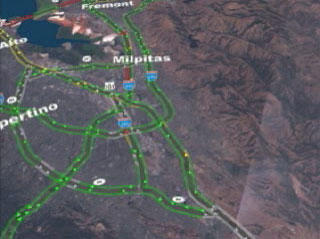
A television station in Sacramento is going to begin broadcasting five-day TRAFFIC forecasts today, according to this story on NewScientist.com.

Here's a snippet:

A traffic forecasting system capable of predicting traffic conditions seven days in advance will go live to the public in California on Wednesday.

Alongside the weather forecast, viewers of KXTV News 10 in Sacramento can now get 3D animations of their local road network, showing not only where the gridlock is but also where it is likely to be.

The system, called Beat-the-Traffic, is the first public traffic forecasting system that combines real-time traffic density and speed with historical trends on major routes.


It looks as though the system is from a company called BeatTheTraffic.com, who combines traffic sensor data (from the DOT) with their own predictive systems, based on season, previous traffic issues, sports events, etc.

This is totally cool. What I am waiting for is the convergence of this info on in-car screens. With so many cars now having GPS screens (as well as DVD monitors), how hard is it to display traffic info? I know the Acura RL has a traffic system on-screen in it's new car, can we expect to see this provided by others?

-aB

Friday, June 24, 2005

Sprint's New Logo


Via Gizmodo, here's a look at Sprint's new logo, updated from the red & white after their merger with NEXTEL.

I like the little logo and the typeface of the wordmark, but the logo is pretty blah. It really doesn't say too much about the company. It could be a logo for a software company, an airline or just about anything.


I think Cingular did a good job with their logo after the merger with AT&T. (Disclosure - I worked on the merger and on the Cingular brand launch.) They decided, correctly that the Cingular "Jack" (and they hate when you call it that) had more positive equity and personality than the AT&T globe. They simply changed the Cingular wordmark from it's Cingular orange color to AT&T Wireless blue.

I'll wait and see if the new Sprint logo grows on me...

-aB

DSL or Cable Modem?


VHS vs. Beta. GM vs. Ford. Pepsi vs. Coke. GSM vs. CDMA/TDMA. Cubs vs. White Sox. Yankees vs. Mets.

Our world is full of choices. We try to make the right one.

Right now, for me, the choice is DSL or Cable Modem at my house. As some of you know, I have recently moved from Atlanta to Pittsburgh, and even after being here a week I still have not hooked up the Internet access at home. (Shame.)

I have two welcome kits sitting on the kitchen counter. One from Verizon for DSL, one from Comcast for a cable modem.

Both sets of hardware were free. Both service plans are $40/month (with six months @ $20).

Now, I've had DSL for a number of years in Atlanta. No problems - probably only a half dozen failures in five years. I was getting 800k-1.2mb/s on my DSL at home.

I've never had an experience with cable modems. The guy who came out to install our cable said that the drop to my house had the capacity for 6mb/s, but that obviously that would slow down as other people on the street logged in, too. He said that they would generally guarantee 1.5 mb/s, which is faster than DSL.

So cable modems seem to win the speed issue. Then there is the issue of dealing with the cable company or dealing with the phone company when there are issues. Nothing like having two crappy choices to pick from.

Well, I'm going to research today and over the weekend and install at least one of them. I think it's honestly going to come down to where I put my desk in the office - close to the cable jack or closer to a phone jack.

-aB

Wednesday, June 22, 2005

Gump's Moved North


Where's Gump Been? We've misssed his thoughts and rants on gadgets, computers, Tiger and marketing.

Gump's been busy, moving north of the Mason Dixon line for the first time in my life. Over the past two weeks, I've sucessfully moved from Atlanta, which has been my home for the past eleven years to Pittsburgh, my new home.

So, goodbye Braves, grits and sweet tea. Hello Steelers, snow and Pepsi products.

I'm looking forward to writing here in Gump Rants about my move and the transition. So far, so good. The people in Pittsburgh are very nice and so far the weather has been incredible - absolutely incredible. (I do realize that it will change come November.)

So, until I get my DSL hooked up at home, expect more sporadic posts to the blog here. Which brings up a question - Cable Modem or DSL? I have welcome kits for both, now I have to decide which one to go with. That sounds like a topic for tomorrow.

-aB

Friday, May 27, 2005

Court Reporter Steno Machines...


Via Gizmodo, I've always wondered how those things the court reporters type on work. You would think that with all of the technology today, they would have found a way to update these things, but I guess if it ain't broke then don't fix it.

This Slate story talks about how the Stenotype machine works. Interesting. Snippet:

It's called a stenotype machine, and it's also used for captioning television broadcasts and general office stenography. The stenotype works a bit like a portable word processor, but with a modified, 22-button keyboard in place of the standard qwerty setup. Modern stenotypes have two rows of consonants across the middle, underneath a long "number bar." Set in front of these are four vowel keys: "A," "O," "E," and "U."


Now, the other thing I want to know is how surveying equipment works. Those little telescopes, the reflectors on sticks... Can't you do all of this with GPS now?

Enjoy.

-aB

Friday, May 20, 2005

Tuesday, May 17, 2005

Sony PS3 Officially Announced


This CNN story does a decent job of showcasing the new PlayStation, due out next spring. I've written here in this post about the Cell processor it will utilize, but this story goes into a bit more detail on the entire package.

Key Points:

  • 35 times the power of the PS2

  • More powerful than the current PS2, XBOX and GameCube combined

  • Utilizes Blu-Ray disks

  • Wireless bluetooth controllers - capacity to handle seven simultaneous controllers/players standard

  • Ability to output two different signals to two different TVs (standard or high-def)

  • Console will be initially available in silver, black and white

  • Supports 1080p high definition format

  • Supports interaction with the PSP handheld via wireless

  • Supports Sony's Memory Stick Duo format as well as SD and CF cards


Pretty neat stuff. I was expecting it to look a bit cooler than the pictures show. Not necessarily disappointed, but not quite the "wow" I was anticipating.

But the specs do wow me.

-aB

Internet Explorer Falling Further Behind, In Several Ways


The gang at IBM dealt a blow to Microsoft's Internet Explorer browser today, announcing that they were making the FireFox browser available to their 300,000 employees. Snippet from Information Week:

Microsoft's Internet Explorer continues lose market share as more consumers and businesses adopt alternative Web browsers. Rival IBM on Friday became the latest company to embrace Mozilla's Firefox browser, making it available to 300,000 employees.

"IBM recognizes a bandwagon when it sees one," says Andy Jaquith, an analyst at the Yankee Group. "Besides, it's migrating its whole operation to Linux."

Firefox clearly has momentum. It has been downloaded more than 50 million times, and members of the open-source Mozilla project have provided funds for advertising to promote the browser. Firefox has features that aren't available in Internet Explorer. And some experts think it's more secure than IE, reason enough for businesses to consider it as an alternative browser.


CNN noted a few days ago that IE market share had dropped to less than 90% for the very first time. Information Week gave Firefox about 8% market share, and interestingly Apple's Safari browser 3% of the market (or virtually all Mac users out there).

This Information Week story announces that the new IE 7 will include tabs, a feature that Safari has had for years and a big differentiator for Firefox. Microsoft IE product manager Dean Hachamovitch realizes the mistake to wait so long for tabs as he explains, "I think we made the wrong decision here [not including tabs] initially, and we're making the right one now."

Sounds like the new IE 7 won't be in beta until this summer. I'd thought that they were shooting for a lot earlier than that. Another big feature in IE 7 that many are waiting for is the built-in RSS reader. I bet that it's going to get a lot worse for Internet Explorer before it gets better. Plagued with security flaws, slower speed and fewer features, Firefox is the best choice on a PC. Safari's still my favorite overall browser, especially the one built into OS X Tiger.

-aB

Friday, May 13, 2005

Finally An iPod FM Transmitter That Doesn't Suck


I am not a big fan of the iTrip, or pretty much any of the current stable of FM transmitters for the iPod. Their signal is just too weak. And unfortunately, I have to use a transmitter in my BMW to be able to listen to my iPod. (In my Infiniti, I have a cassette player, so I can use that adapter, but my BMW is the model year before they added the iPod functionality discussed at iPodYourBMW.com).

Well, I have finally found something that works. It's the Monster iCarPlay Wireless Plus. It works.

It's not wireless like the iTrip, but it more than makes up for that with the quality. You plug it into the cigarette lighter plug, and it broadcasts a pretty strong signal on any FM frequency you want. Plus, it charges your iPod while it works (and it's a smart charge to prevent overcharging the iPod battery).

Another good thing is that it pulls the audio signal from the dock connector, rather than the top earphone jack, so it's a clean "line audio" signal. Nice.

It costs $80, so it isn't cheap. But it's definitely the most powerful of the transmitters I've tried. I put it on the same frequency as Star 94-FM here in Atlanta, and it blew that Star 94 (and it's great mix of today's top hits!) way back to Jessica Simpson-ville. And if that's all it did, it would be worth the $80 price alone.

-aB